


Palestinian Poets Captivate a Sold Out Crowd at Telegraph Hill Books
October 7 marked the three-year anniversary of the Gaza War. And while a cease-fire began last fall, it’s done little to ease the suffering of innocent Palestinians in Gaza. Death and devastation are still part of their daily lives as Israel continues to attack them and a growing humanitarian crisis unfolds.
But on Friday, October 16, the strength and resilience of the Palestinian people were evident during a sold-out poetry reading at Telegraph Hill Books. The Litquake event— sponsored by the Center for the Art of Translation— featured seven Palestinian poets published in the anthology “Heaven Looks Like Us: Palestinian Poetry.” They included Zeina Hashem Beck, Ahmad Diab, Janine Mogannam, Deema Shehabi, Jen Siraganian (who also emceed the event) and Priscilla Wathington. (Omar Zahzah had a last minute conflict and couldn’t be there in person, but Siraganian read one of his poems.)

“The apartheid and genocide are unceasing, but tonight as you hear seven Palestinian voices, I hope you will see that their voices are not ceasing,” Siraganian said after welcoming the audience. “These poets use their words to honor and celebrate and question and eulogize and remember and inspire. And most of all, to resist.”
Edited by George Abraham and Noor Hindi,“Heaven Looks Like Us” includes work by more than 100 Palestinian poets from around the world. Some of the evening’s readers shared their pieces from the anthology; others shared work from new or past projects. And a couple read poems by other writers featured in the book. Besides eloquently expressing a myriad of emotions about Palestine, the loss of loved ones, and the atrocities their people continue to endure, the poems captivated the audience with their varied styles and vivid imagery.

Shehabi, for example, read the bittersweet yet hopeful “Not Just Passing” by Heba Abu Nada. Fittingly, her bittersweet yet hopeful poem opens the anthology. Ten days after writing it, the author and women’s rights activist was killed in her Gaza home by an Israeli airstrike.
“Oh little light in me, don’t die, even if all the galaxies of the world close in,” Abu Nada prophetically reminds herself and her readers.
Shehabi then shared two of her own pieces, including “Ghazal,”which includes a refrain she adapted from the opening line of the poem “Farewell” by Spanish poet Frederico Garcia Lorca: “If I die, leave the balcony open.” In Garcia Lorca’s poem, the balcony represents the thin barrier between his death and the world that will continue without him. Shehabi’s modified version of the line packs a powerful punch at the end of each couplet. Here’s an example:
“Angels with daggers march through the funeral air of burned children, and you’re the witness when the balcony opens.”
Diab read “UNRWA,” a poem inspired by his experience with the United Nations Relief and Works Agency as a Palestinian who grew up in Syria. He wrote the thought-provoking, witty piece in the style of a dictionary entry with 22 different definitions of his personal interpretation of the UNRWA
Throughout the evening, the poets expressed gratitude to the audience for being there. Some, like Mogannam, also alluded to the pain of witnessing their people struggle from afar for so long.
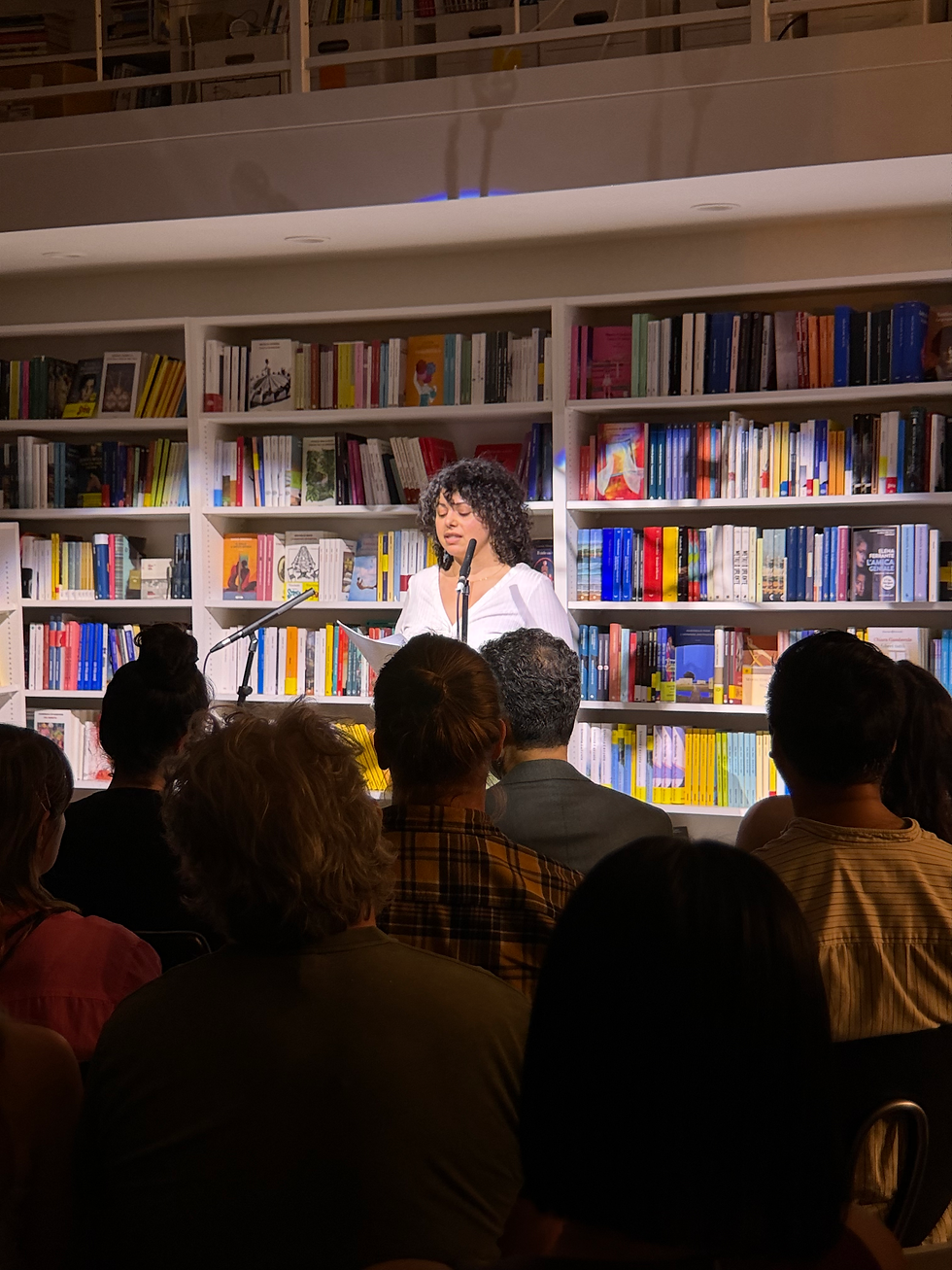
“The past three years have been excruciating for Palestinians, our friends, and our families,” she said when it was her turn to take the mic.“It really means a lot to see such a packed house.”
She then shared “Dead Sea Existential,” her poem from the anthology. In it, she deftly conveys the unsettling sense of feeling like a poser when she visits the Dead Sea as a Palestinian American, a sentiment that echoes the displacement Palestinians in the Middle East know all too well.
“...in self denial, anger lashing at my skin, rubbing salt into generations-old wounds,” she read. “I fear the plunge would prove I am nothing more than tourist, a watered down version of someone I’m supposed to be…”
After the reading, the bookstore buzzed with activity as attendees gathered around the poets to thank and congratulate them. And to buy copies of the anthology. If you missed the event but would like to buy “Heaven Looks Like Us,” drop by the store or order it online.


Comments